Relume 2.0 rollout: From plug-in to platform. Shipped end to end.
By Andrew McKay, Principal Product Designer
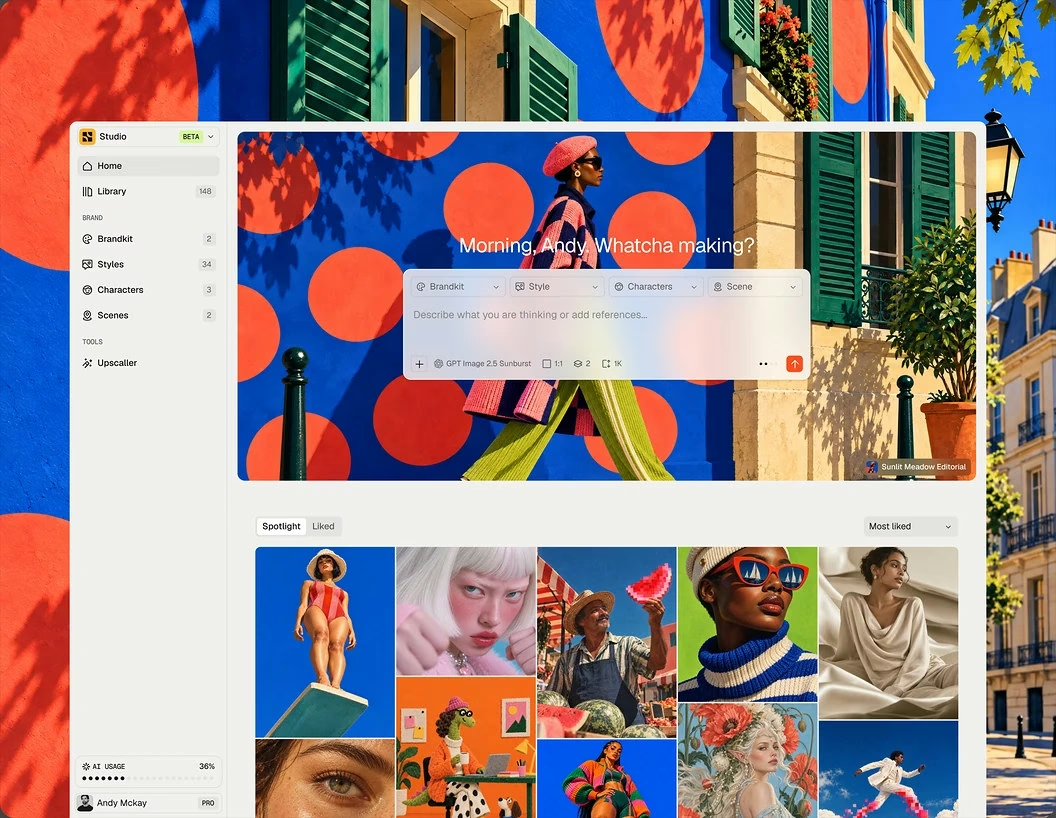
Relume 2.0 turned a plug-in into a platform that publishes real sites. I led everything people saw of it: the brand, a web design system shared with the product, a tool that let marketing make its own assets, and relume.ai, built in two weeks with Claude.
- Role
- Principal designer, brand lead
- Team
- Solo, end to end
- Scope
- Brand, System, Tooling, Website
- Built with
- Claude, Webflow MCP server
- Launched
- 2 June 2026
- Numbers from
- The first month after launch
- +17%: Visit to sign-up
- 2d→15m: Wait for an asset
- 23: Pages by marketing
Shift
The export ceiling
Relume used to stop short of the finish line. You built with it, then exported to Figma or Webflow to actually ship, which made our ceiling someone else’s user base. 2.0 publishes on its own.
That asks people to put their real sites on Relume, and nobody trusts a plug-in with production. If the brand still looked like a plug-in, 2.0 would launch as one and the export ceiling would stay. With the product redesign done, I moved to the brand to land it with 2.0.
Two in three, projects ended in an export: Relume built the site, then people left to ship it somewhere else, and took their audience with them.
Dan: @Andy the product’s in a good spot. We need you over on the marketing side now to do your thing. Go wild!
Andy: On it. We’re a standalone product now, not tied to Webflow or Figma, so let’s go bold and make a statement. I’ll restructure the site’s IA so it explains the product as it is now.
The Publish hero: a prompt over the real product, with Playground’s voxel models turning either side.
Brand
A brand built to be used
People decide whether to trust a tool with production by how it behaves at its smallest: a 12px badge, a disabled button, an error. So the brand was tested there, not on a poster, and that test decided what stayed. The block mark was what people already knew, and it held at 12px; the display face fell apart below 16px, so it went.
Both founders were attached to the old brand, and not wrong to be. The pink is what made 2.0 look like a new product rather than a plug-in. I took them through each choice on the same 12px sheet I tested on, so nothing at launch was new to them.
Dan: @Andy love where this is going. Wasn’t expecting pink, but it’s so distinct. Keep going, can’t wait to see where you take it!
One family for 2.0: each product its own colour and mark, every palette built the same way.
System
Product and web, one system
The site had its own type, colours and components, so every product change meant redoing pages by hand. I put the new brand into the product’s design system, and had Claude rebuild each Storybook component as a Webflow component on the same tokens. We agreed the tokens with engineering before any component, so nothing was built twice; they moved the app onto them, and I reviewed every change that touched them.
The trade is real: marketing lost the freedom to invent a layout on a Tuesday. What we got back is a site that can’t drift from the product, and marketing has built 23 pages from it since launch on its own.
Pricing, built from the product’s own components on the shared tokens; the plan art is Playground’s voxels, running live.
Tool
A tool, not a queue
Every asset marketing needed waited on me, often for two days. I tried the AI asset tools first; each was fine for one output, but none held a brand across a set. Most design systems stop at components; this one had to reach the illustrations.
So I sat with marketing for a week, listed what they asked me for most, and built them Playground from that list: the brand’s voxels, shaders and canvas animation on the system’s variables. Any frame freezes to SVG with its colours bound to the tokens; motion ships as code, so the same voxel models run live on relume.ai. Marketing now has an asset live in fifteen minutes.
Abhi: @Andy going to get Jono on the marketing collateral for launch. Mind creating a few directions to help him?
Andy: I’ll go one better. I built Relume Playground with all our marketing assets, scheme combinations and animations built in. Jono can jump in and export SVGs and animated HTML straight from it.
GROW is Playground’s text shape, set straight into the page with the tool’s own motion: no export, no hand-off.
Start with context: Playground’s orbit, scrubbed by scroll, carrying a project’s scattered content round the copy.
Build
Two weeks, built with Claude
Then I had two weeks to build the site in Webflow, on those components, with Claude driving it through Webflow’s MCP server, my first build that way. Claude was quick at the bulk: scaffolding pages, binding variables, wiring interactions. It was weak at layout, so I laid out every page and had it rebuild to match.
It sat outside Relume, because our own product wasn’t ready for it yet. That turned out to be the most useful part: an 11-item list of what the product needed before a designer could build this site inside it. Seven have shipped.
Teams, on the Publish page: everyone on the same site at once, cursors and all, coded, not filmed.
Result
More visits became sign-ups
Four weeks before launch I put PostHog on the old site for a baseline, with one hypothesis: a site that sells publishing, built from the real product, turns more visits into sign-ups. To separate the site from the release I held 10% of visitors on the old design, with 2.0’s copy, for four weeks. The new site turned 3.4% of visits into sign-ups against the holdout’s 2.9%, a 17% lift from design alone.
The extra sign-ups held up: 24% published a site within 30 days, against 23% from the holdout. The one page that fell was pricing, so I rebuilt its comparison table in week two, and by the holdout’s last week it was level.
The 2.0 film, made for launch day: the first thing relume.ai plays.
The closing call, with Playground’s snakes crawling the margins, over a footer built from the product’s components.
I’ve worked closely with Andy for a few years, and he’s easily one of the top 1% designers I’ve ever worked with.
If you want to know what Relume feels like, look at Andy’s work. He has owned our brand end to end and kept it consistent from marketing all the way into the product.